The transition from experimental AI clips to commercially viable video campaigns is marked by a single, stubborn hurdle: consistency. While generating a single, visually arresting four-second clip is now trivial, producing a sequence of twelve shots that maintain the same lighting, character geometry, and temporal logic remains a significant operational challenge. In the industry, we often refer to the randomness inherent in these models as “generative entropy.” If left unmanaged, this entropy results in “flicker,” character morphing, and a lack of narrative cohesion that immediately signals “AI-generated” to the viewer in a negative way.
For creative operations leads and video editors, the goal isn’t just to find a tool that produces high-resolution frames. The goal is to build a repeatable asset pipeline where the output of an AI Video Generator can be treated as raw footage—editable, color-gradable, and structurally sound. To achieve this, teams are moving away from “lottery-style” prompting toward more disciplined workflows that prioritize control over sheer visual spectacle.
The Anatomy of Generative Entropy
To solve the problem of inconsistency, we first have to identify where it occurs. In traditional cinematography, consistency is maintained through lens choice, lighting rigs, and continuity supervisors. In the generative space, these physical constants are replaced by mathematical weights. Entropy usually manifests in three distinct areas:
- Temporal Instability: Objects or backgrounds that change shape or texture from frame 1 to frame 60. This is often seen as “boiling” pixels or textures that crawl across a surface.
- Character Drift: A person’s facial features or clothing details subtly shifting between different camera angles or shots.
- Physics Hallucinations: The way a model interprets motion, such as a hand merging into a coffee cup or hair moving in a way that defies gravity.
Managing these requires a strategic approach to how we prompt and which models we deploy for specific tasks. Not every model is suited for every shot. Some excel at slow, cinematic pans, while others handle complex human locomotion with more grace.
Establishing the Baseline Workflow
A professional workflow begins with a clear separation between the “base layer” and the “refinement layer.” High-performing teams often use a centralized AI Video Generator to establish the primary motion and composition. The “base” shot provides the choreography—the general movement of the camera and the subject.
However, it is vital to acknowledge a current limitation: no single-pass generation is likely to be perfect. Expecting a model to get the lighting, the character, and the physics right in one go is a recipe for wasted credits and frustration. Instead, the focus should be on getting the “bones” of the shot right. If the motion is fluid and the composition aligns with the storyboard, the finer details can often be corrected in post-production or through localized re-generation.
The Multi-Model Strategy
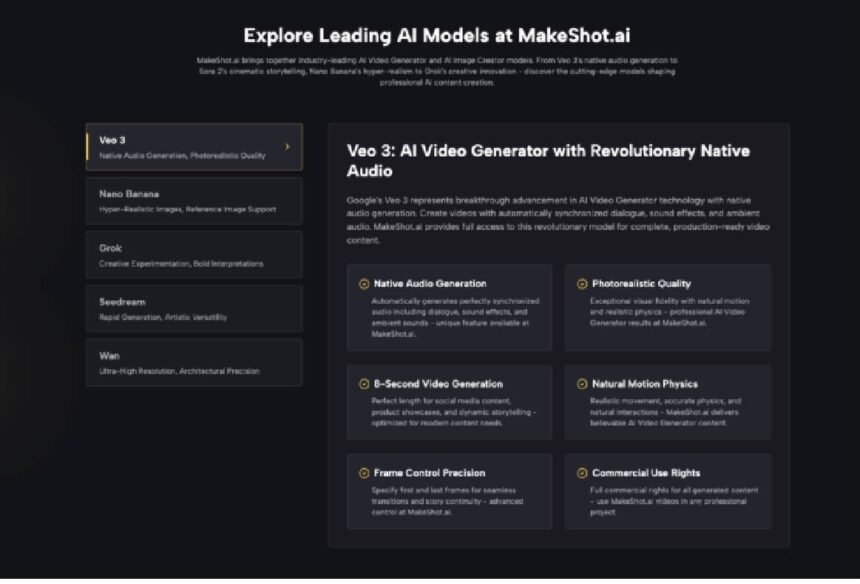
Different models have different “latent biases.” Some models, like Google’s Veo or the newer iterations of Kling, have been trained on vast datasets that emphasize cinematic realism. Others might be more “plastic” in their interpretation of motion. A key part of quality control is matching the shot requirement to the model’s strengths.
For instance, if a campaign requires a wide landscape shot with minimal subject movement, a model that prioritizes high-texture resolution is the right choice. Conversely, for a close-up of a human face expressing emotion, a model with better temporal consistency in facial muscles is necessary. By using a platform that aggregates these various engines, teams can switch “lenses” without switching workflows.
Tactics for Visual Continuity
Maintaining consistency across a series of shots requires more than just repeating the same prompt. In fact, using the exact same prompt for different camera angles often leads to different results because the model interprets the “context” differently.
Seed Management and Prompt Weighting
While many web-based tools obscure the “seed” (the starting noise pattern for a generation), professional-grade platforms allow for more granular control. When you find a seed that produces a character or environment that fits the brand guidelines, that seed becomes a valuable asset.
Prompting for consistency also involves “structural prompting.” Instead of describing the whole scene every time, editors are moving toward a modular prompt structure:
- Core Subject: (e.g., “A woman in a blue linen blazer”)
- Environment: (e.g., “Minimalist concrete studio, soft morning light”)
- Motion/Camera: (e.g., “Low angle tracking shot, slow push-in”)
By keeping the Core Subject and Environment tokens identical across shots, you reduce the variables the model has to interpret, thereby lowering the entropy.
The Limitation of Prompt Adherence
It is important to reset expectations regarding prompt adherence. Even with advanced models, there is often a “disconnect” between a complex text description and the visual output. If a prompt includes four or five specific details (a blue watch, a scar on the left cheek, a silver ring, and a specific brand of sneakers), the model will likely drop or hallucinate at least two of those. Professional editors mitigate this by keeping prompts lean and focusing on the most important visual anchors, knowing that specific brand details—like a logo on a shoe—are better handled through traditional VFX or “Inpainting” rather than raw generation.
Structural Integrity and Post-Production
The most significant shift in the AI video landscape is the realization that the AI Video Generator is a production tool, not a replacement for the entire pipeline. To make generative video usable in real campaigns, it must be integrated into NLE (Non-Linear Editing) software like Premiere Pro or DaVinci Resolve.
Temporal De-noising and Interpolation
Even the best generations can suffer from slight micro-stutters. Tools that provide temporal de-noising can smooth out these artifacts. Additionally, generating at a lower frame rate (like 24fps) and then using optical flow or AI-driven interpolation to bring it up to 60fps can often hide small physics errors that occur at the sub-frame level.
Color Grading as a Unifier
One of the easiest ways to hide “generative drift” between shots is through aggressive and consistent color grading. By applying a unified LUT (Look-Up Table) across all AI-generated assets, an editor can pull disparate shots into the same visual world. If the skin tones vary slightly between Shot A and Shot B, a dedicated color pass can normalize these differences, making the sequence feel intentional rather than accidental.
Evaluation Frameworks for Quality Control
How does a team decide if a generated clip is “good enough”? Without a framework, quality control becomes subjective and slow. We recommend an “S-M-C” evaluation:
- Structure (S): Does the composition match the storyboard? Is the camera move physically possible?
- Motion (M): Is the movement fluid, or are there “teleportation” artifacts where pixels jump across the screen?
- Coherence (C): Does the subject look like the same person/object from the previous shot
If a clip fails the “Structure” test, it is usually discarded. If it fails “Motion” or “Coherence,” it might be fixable through masking or re-generating specific segments of the frame.
The Reality of High-Motion Complexity
A second moment of limitation occurs when dealing with complex human interactions. Currently, most AI video models struggle with “entanglement”—two people hugging, someone tying their shoelaces, or complex hand movements like shuffling cards. In these instances, the “physics engine” of the latent space often breaks down.
For real-world campaigns, the strategic choice is often to avoid these high-entropy shots or to film them traditionally and use AI for the background or environment. Understanding where the technology currently “peaks” prevents teams from wasting hours trying to force a model to do something it isn’t yet capable of performing with high fidelity.
Scaling the Pipeline with AI Video Generator Platforms
For agencies and content teams, the goal is “time-to-market.” Using an integrated platform allows for a centralized repository of “winning” prompts and settings. This collective intelligence means that if one editor discovers a specific combination of settings that produces perfect liquid simulations, that knowledge can be instantly applied to the rest of the campaign.
The process of scaling involves creating “Master Templates” for different types of content. For example, a social media ad campaign might have a template for “Product Close-ups” and another for “Lifestyle Backgrounds.” By standardizing the input parameters, the team can produce a high volume of assets that all feel part of the same brand family.
Grounding Expectations in Commercial Delivery
We are currently in a hybrid era. The most successful AI video campaigns are not 100% AI; they are 70% AI-generated footage enhanced by 30% traditional post-production. This “Cyborg” workflow is the most efficient way to maintain professional standards.
When evaluating an AI Video Generator, focus less on the “wow factor” of a single cherry-picked demo and more on the consistency of the results across ten different attempts. The true value of these tools lies in their reliability. Can they produce a usable shot on the third try, or does it take thirty? For a commercial team, that difference is the margin between profit and loss.
Ultimately, managing generative entropy is about moving from “creation” to “curation and control.” By understanding the technical limitations—such as physics hallucinations and character drift—and implementing a structured workflow that includes seed management, multi-model selection, and traditional post-production, teams can finally use generative video for more than just social media experiments. They can use it to build coherent, brand-aligned, and high-impact visual stories that stand up to professional scrutiny.