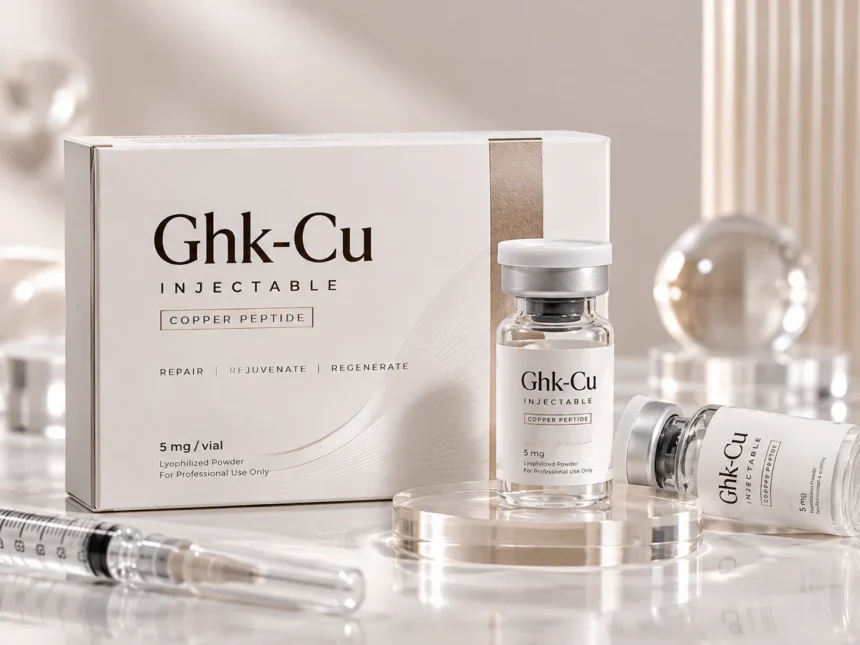
GHK-Cu is one of the smallest peptides studied in modern biology, just three amino acids bound to a copper ion, yet it has generated decades of research interest. For anyone following peptide science in the UK, it is worth understanding what GHK-Cu actually is and why laboratories keep coming back to it.
What Is GHK-Cu?
GHK is the tripeptide glycyl-L-histidyl-L-lysine. It was first isolated from human plasma in 1973 by Dr Loren Pickart, who noticed that it binds copper(II) ions very strongly. The copper complex, GHK-Cu, is the form most studied today. Levels of GHK in human plasma have been reported to fall with age, which is one reason it attracted early attention.
What Has Been Studied?
Most GHK-Cu research falls into three areas. The first is connective tissue: cell-culture studies have looked at how it influences collagen and glycosaminoglycan production by fibroblasts. The second is wound models, where it has been examined in animal studies of tissue repair. The third is gene expression: analyses using the Broad Institute Connectivity Map suggested GHK may influence the activity of a large number of human genes, a finding that has driven much of the recent interest.
It is important to be clear that much of this work is in vitro or in animals. GHK-Cu is well established as a cosmetic ingredient in topical skincare, but injectable research-grade GHK-Cu is not a licensed medicine in the UK.
GHK-Cu in Blends
GHK-Cu is also a core part of research blends such as GLOW and KLOW, where it is combined with BPC-157 and TB-500 (and KPV in KLOW). These blends let researchers study several repair-related pathways in a single vial.
What to Look For
GHK-Cu powder should be a distinctive blue, a sign of the copper complex. A reliable supplier will provide an independent certificate of analysis showing HPLC purity and mass-spectrometry identity. For more detail on sourcing and storage, see this UK research guide to GHK-Cu. Revial Labs supplies GHK-Cu 100mg research vials from UK stock.
All compounds discussed are supplied for in vitro laboratory research only. They are not licensed medicines in the UK, and nothing here is medical advice.