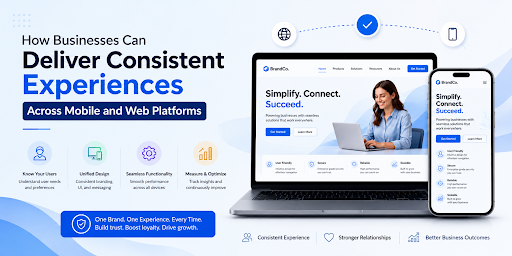
Very few companies set out to build a fragmented digital presence. It happens gradually. A website is launched first, a mobile app follows two years later under a different vendor, and a customer portal gets bolted on when sales asks for it. Each piece works. Together, they behave like three unrelated products wearing the same logo.
For customers, the inconsistency is obvious long before it becomes obvious internally. A discount visible on the web does not appear in the app. An order placed on mobile takes hours to reflect in the account history on desktop. Support agents ask users which platform they were on, because the answer changes what they are able to see.
This is rarely a design problem. It is an architecture problem. When business logic is duplicated across platforms instead of centralized, every new feature has to be built, tested, and maintained multiple times, and small divergences compound into visibly different products. Organizations that treat their custom web application development services investment as a foundation rather than a one-time project tend to avoid this trap, because the foundation is designed to serve more than one channel from day one.
The stakes rise as the business grows. Scaling a company means scaling the number of touchpoints, integrations, regions, and internal teams touching the same systems. Weak architecture does not fail loudly at that point. It slows everything down.
Release cycles stretch. Engineering effort shifts from building new capability to reconciling old inconsistencies. The same is true on the mobile side, where teams often discover that their custom mobile application development services partner built an app that duplicates backend logic instead of consuming it.
Enterprise-grade thinking is what separates systems that absorb growth from systems that buckle under it. It is worth defining what that actually means, because the term gets used loosely.
What Defines an Enterprise-Grade Application
Scalability. The application handles ten times the current load without a rewrite. This is less about raw server capacity and more about whether the design allows components to scale independently. A checkout service under seasonal pressure should not require scaling the entire platform.
Security. Authentication, authorization, encryption, and audit trails are handled centrally rather than reimplemented per platform. When security logic lives in three places, it is only as strong as the weakest of the three.
Performance. Consistent response times under real conditions, not ideal ones. Mobile users on unstable connections have different tolerances than desktop users, and the system should account for that rather than assume parity.
Reliability. Failures are contained. A degraded recommendation engine should not take down the ability to place an order. Graceful degradation is a design decision made early, not a patch applied later.
Integration capability. The system exposes clean, documented interfaces that other systems can consume. This is the single most underrated attribute, because it determines how expensive every future initiative will be.
Consistency across mobile and web is a natural byproduct of these five traits. When both platforms consume the same well-designed services, they behave the same way without anyone having to enforce it manually.
Key Pillars for Long-Term Growth
Modular Architecture
The microservices versus monolith debate is often framed as a technology choice. It is really a question of organizational readiness.
A well-structured monolith is entirely appropriate for many mid-sized businesses. It is simpler to operate, easier to debug, and cheaper to run. The problem is not monoliths. The problem is monoliths with no internal boundaries, where every module reaches into every other module.
Microservices make sense when multiple teams need to ship independently, when parts of the system have genuinely different scaling profiles, or when regulatory requirements demand isolation. They also introduce distributed system complexity that a small team will struggle to manage.
The practical middle ground is a modular architecture with clear domain boundaries. Whether those modules eventually become separate services or remain within a single deployment is a decision that can be deferred, provided the boundaries were drawn correctly in the first place.
Cloud-Native Development
Cloud-native is not the same as hosted in the cloud. Lifting an existing application onto a cloud provider delivers some operational benefit and very little architectural benefit.
Cloud-native means the application assumes elasticity. Instances are disposable. Configuration is externalized. State lives in managed services rather than on application servers. Deployments are automated and reversible.
The business outcome is predictable cost and predictable recovery. Infrastructure expands with demand instead of being provisioned for a peak that occurs twice a year.
Data-Driven Decision Making
Consistency across platforms requires knowing where inconsistency exists. That requires unified instrumentation.
Most organizations analyze web analytics and mobile analytics separately, which makes it nearly impossible to follow a single customer across channels. A shared event schema and a common identity layer let you answer questions that fragmented tracking cannot: where users switch devices, where the journey breaks, which platform underperforms and by how much.
Automation and AI Readiness
AI readiness is mostly a data readiness question. Models are only useful when they can access clean, well-structured, permissioned data through stable interfaces.
Organizations that have already centralized their business logic and standardized their data contracts can adopt new capabilities in weeks. Organizations with siloed platforms spend most of their effort on plumbing before any value appears.
Common Mistakes Businesses Make
Optimizing for the next release instead of the next three years. Short-term thinking is understandable under deadline pressure. The cost is invisible at first and then suddenly dominant, usually around the point where the team spends more time maintaining than building.
Deferring scalability entirely. The advice to avoid premature optimization is sound and frequently misapplied. It refers to micro-level performance tuning, not to architectural decisions. Database design, service boundaries, and API contracts are extremely expensive to change later.
Selecting a technology stack for the wrong reasons. Stacks get chosen because they are trending, because one influential engineer prefers them, or because a vendor recommended what they happened to specialize in. The better criteria are talent availability in your market, ecosystem maturity, long-term support commitments, and fit with the actual problem.
Treating mobile as a smaller version of web. Mobile has different constraints around connectivity, battery, session length, and platform review cycles. A system that assumes parity produces an app that feels like a wrapped website.
Best Practices for Building Future-Ready Applications
Plan before you build. A short discovery phase covering domain modeling, integration mapping, and non-functional requirements typically costs a fraction of a single sprint and prevents months of rework. Define what scale you are designing for and what you are explicitly not designing for.
Choose a partner who asks uncomfortable questions. The most valuable technical partner is the one who pushes back on requirements, questions assumptions, and is willing to recommend a smaller build than you asked for. Vendors who agree with everything are optimizing for the contract, not the outcome.
Build feedback loops into the process. Continuous optimization requires observability, structured release practices, and a mechanism for retiring code that no longer earns its place. Architecture that is never revisited becomes legacy regardless of how well it started.
Establish a shared design system. Once the backend is unified, visual and interaction consistency becomes a matter of shared tokens, components, and patterns maintained in one place.
A Practical Example
A mid-sized logistics provider ran a customer web portal and a driver mobile app built by separate teams. Shipment status logic existed in both codebases. The two implementations drifted, and customers regularly saw a status on the portal that drivers were not seeing in the app.
The fix was not a redesign. The team extracted shipment state management into a single service with a documented API, then rebuilt both frontends to consume it. Status logic now lived in one place.
The measurable outcomes were the ones the business cared about. Status-related support tickets dropped substantially. Feature delivery accelerated because changes required one implementation instead of two. When the company later added a partner-facing integration, it consumed the same service and required no new business logic at all.
That last point is the real return. Good architecture makes the next project cheaper than the last one.
Conclusion
Consistency across mobile and web is not achieved through better coordination between teams. It is achieved by removing the need for coordination, by ensuring both platforms draw from the same source of truth.
That requires deliberate architectural decisions made early, when they are still inexpensive. Modular boundaries, cloud-native design, unified data, and clean integration points are not premature investments. They are the difference between a system that supports growth and one that quietly limits it.
The organizations that scale well are rarely the ones that built the most. They are the ones that built the right foundation and then reused it relentlessly.