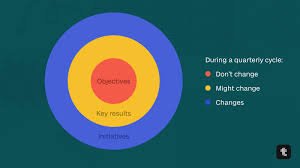
I’ll be honest — for the longest time, our company was setting goals that didn’t really go anywhere.
Every quarter, we’d create a long list of things we wanted to “improve,” “optimize,” or “grow.” They sounded impressive in meetings, but three months later, no one remembered half of them.
We weren’t failing because we didn’t care. We were failing because we had no system for focus.
That changed the moment we discovered OKRs.
The Simplicity That Clicks
If you haven’t heard of them before, OKRs stand for Objectives and Key Results.
They’re simple on paper, but they can completely transform how your team sets and tracks goals.
- Objectives are what you want to achieve — they’re big, inspiring, and often a little uncomfortable.
- Key Results are how you’ll measure whether you’re getting there — specific, measurable, and time-bound.
Here’s an example from one of our first OKR cycles:
Objective: Improve the onboarding experience for new customers.
Key Results:
- Increase product activation rate from 60% to 85%.
- Reduce average onboarding time from 10 days to 5.
- Collect onboarding feedback from 80% of new users.
Suddenly, “improve onboarding” wasn’t just a wish. It was a measurable mission. Everyone on the team could see what success looked like — and that clarity changed everything.
OKRs Aren’t a Buzzword — They’re a Mindset
What I love about OKRs is that they force you to focus.
You can’t hide behind vague statements like “drive engagement” or “increase brand awareness.” You have to commit to outcomes that can be measured, reviewed, and discussed.
Even better, OKRs make teams think bigger. The idea isn’t to hit 100% every time — it’s to stretch, to aim high, to take smart risks.
If you hit 70% of a truly ambitious goal, you’ve probably moved the business further than you would have with a “safe” one.
But here’s where many teams stumble: it’s not the OKRs themselves that fail — it’s how they’re managed.
The Spreadsheet Struggle
We started our OKR journey with a spreadsheet. It was… fine.
At first, it worked. Everyone could see the company’s objectives, and teams could list their key results underneath. But after two quarters, it turned into a mess.
- Updates were inconsistent.
- Some teams forgot to review their OKRs.
- No one knew which version was the latest.
Basically, the tool became the bottleneck.
That’s when we decided to look into OKR software — and I wish we had done it sooner.
How OKR Software Changed the Game
Here’s the thing: OKRs themselves are simple. But keeping them alive across multiple teams, projects, and priorities isn’t. That’s where good OKR software earns its keep.
The right tool doesn’t just store your goals — it makes them part of your daily rhythm.
Here’s what we noticed right away:
- Everything Became Visible
With OKR software, everyone — from leadership to new hires — could see the company’s priorities in one place. It gave us alignment without endless meetings.
- Progress Was Automatic
We connected our OKR platform to our project management tools. As tasks got completed, progress on our key results updated automatically.
No one had to chase down numbers or build last-minute reports.
- Check-Ins Got Easier
Instead of waiting for quarterly reviews, we started doing quick weekly check-ins inside the platform. It took 10 minutes, but it kept everyone focused and accountable.
- Data Turned Into Insight
Most OKR tools have analytics dashboards that show how goals are trending. That made it easy to see which objectives were thriving — and which ones needed attention early on.
Finding the Right OKR Tool for You
There’s no shortage of OKR software out there — Profit.co, WorkBoard, Perdoo, Weekdone, and ClickUp Goals are just a few examples.
Choosing the right one comes down to your company’s size, workflow, and how tech-savvy your team is.
If you’re just starting, pick something lightweight and easy to adopt. If you’re scaling fast, go for a platform with strong analytics and integrations.
The tool itself isn’t the point — it’s the consistency it enables.
What OKRs Taught Us
After a year of using OKRs (and the software to support them), here’s what I’ve learned:
- OKRs work best when they’re visible and reviewed often.
- The best goals are ambitious but realistic.
- Simplicity wins — too many objectives kill focus.
- Tools help, but culture is what sustains it.
OKRs didn’t just change how we planned; they changed how we thought. Every discussion — from product decisions to hiring — started with, “Does this move us closer to our objectives?”
The Bottom Line
If you’re feeling that familiar chaos — everyone busy, but progress unclear — OKRs might be what you need.
They bring structure without rigidity and ambition without confusion.
And once your team gets the hang of it, adding OKR software will take the system from theory to habit. It turns goals from static text into something living, visible, and measurable.
Because at the end of the day, OKRs aren’t about checking boxes. They’re about helping your people see where they’re going — and giving them the tools to actually get there.