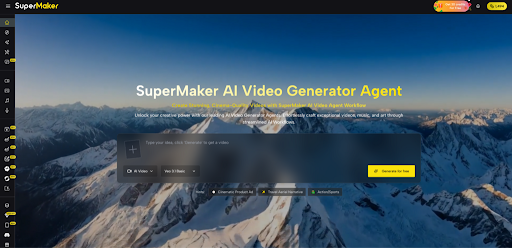
There is a growing difference between tools that generate content and tools that help people finish projects. That difference may sound subtle, but in practice it defines whether a platform becomes part of someone’s workflow or remains a curiosity. An AI Video Generator Agent points to the second category. It suggests that the role of AI is not just to create a short clip from a sentence, but to help users move from concept to publishable output with fewer breaks in the process.
That idea matters because modern creators are rarely struggling to produce “something.” They are struggling to produce something usable, consistent, and timely. A rough clip is easy to admire but hard to deploy. A system that joins ideation, visual generation, voice, music, and final adjustment becomes more relevant because it addresses the actual bottleneck. In my reading of SuperMaker, the platform is trying to solve that broader problem. It is less about a single stunt and more about reducing the invisible labor around creation.
Why Finished Output Matters More Than Raw Generation
A major reason AI content tools feel inconsistent is that many of them solve only the most visible part of the job. They generate an image, a voice, or a clip, but leave the user to stitch the rest together. That can still be useful, but it often turns the workflow into a relay race between tabs.
The Real Task Is Media Assembly
Most creators do not need a clip in isolation. They need a complete piece. Even something short usually depends on pacing, voice, sound, coherence, and a final version that feels intentional. Once that is understood, the value of a platform changes. Its importance lies not only in output quality, but in how well it helps organize the surrounding work.
A Platform Becomes Stronger When It Carries Context
Context is often what gets lost in fragmented workflows. A creator starts with an idea, generates something promising, then breaks continuity while moving assets across tools. A more integrated system keeps that thread alive. It gives the project a better chance to remain emotionally and stylistically consistent.
How SuperMaker Seems Built Around Completion
SuperMaker appears to take that problem seriously by structuring the platform as a connected creative environment. Video is central, but it is not isolated. Around it are image tools, voice tools, music generation, and a conversational interface that encourages iterative direction rather than pure technical adjustment.
Video Generation Is The Main Entry Point
AI Video Generator positions video as the core medium. That makes sense because video naturally absorbs other forms of generated content. Images can become scenes, voice can become narration, and music can shape emotional tone. By placing those parts around a central video workflow, the platform signals that it wants to support complete projects rather than disconnected assets.
Images Function As Inputs And Extensions
The image layer has an important role because not every project begins with text alone. Some users start with visual references, key frames, product photos, or concept art. In that sense, image tools are not peripheral. They expand the ways a project can begin and evolve.
Voice And Music Move The Project Toward Usefulness
Audio often decides whether AI media feels incomplete or ready. A silent visual draft may look good, but once voice and music are added, the material becomes much closer to a real deliverable. That is why their placement inside the platform matters. It reduces one of the most common gaps between generation and actual use.
The Official Workflow Is Simple But Revealing
The platform’s own process description offers a practical way to understand how it works. It does not pretend the system is magical. Instead, it breaks the flow into a clear sequence that resembles modern creative production.
Step One Defines The Starting Vision
The first action is prompt input. This is where the user describes what they want to make. The prompt acts as both instruction and direction. It is the initial framing device for the project.
Step Two Converts Vision Into Motion
The second stage is generation. Here, the prompt or source input becomes moving visual material. This is the moment where the concept becomes something visible enough to evaluate and refine.
Step Three Expands The Work With Audio Layers
The enhancement step introduces voice and music. This part of the process matters because it changes the output from a visual test into something closer to finished media. Audio adds pacing, atmosphere, and intention.
Step Four Brings The Project Toward Release
The publishing phase completes the cycle. It provides space for final refinement and export. That step acknowledges that creators do not only need generation. They need a last point of control before the work leaves the platform.
What Makes This More Than A Basic Generator
A useful way to evaluate the platform is to compare the logic behind it with the logic of more fragmented tools.
| Dimension | Isolated Generator Model | SuperMaker Agent Model |
| Primary goal | Produce a clip | Support a full project flow |
| Input method | Usually single prompt focused | Prompt plus wider workflow context |
| Audio handling | Often external | Brought into the workflow |
| Project revision | Repeated manual handoff | More centralized iteration |
| User mindset | Test and export | Build and refine |
| Main advantage | Fast first result | Stronger creative continuity |
Why This Structure Fits Current Creator Needs
The rise of short-form media has changed expectations. Creators need to produce more often, not just more beautifully. That makes workflow efficiency more valuable than ever. A system that lowers coordination effort can have real practical value, especially for independent creators, lean teams, and marketers.
Speed Alone Is No Longer Enough
Fast generation is helpful, but speed by itself is not a durable advantage. If the clip still needs to be rebuilt elsewhere, the time saved in generation can be lost in assembly. What matters more is whether the total process feels manageable.
Integrated Systems Reward Repetition
A creator who publishes regularly needs repeatable structure. That is one reason unified platforms may gain traction. When the project path remains similar from idea to export, it becomes easier to build habits, templates, and consistent output.
Repeatability Often Matters More Than Peak Results
In creative production, the best tool is not always the one that produces the single most impressive sample. It is often the one that can deliver good enough results repeatedly without exhausting the user. That is an underrated strength.
Consistency Supports Real Creative Confidence
When users know roughly how a project will move through the system, they are more likely to experiment. That confidence can increase creative ambition because the workflow feels less risky and less chaotic.
Where Expectations Should Stay Grounded
Even with a more complete workflow, the platform does not remove the need for human direction. It simply reduces structural friction.
Prompt Quality Still Matters Deeply
The platform can organize production, but it still relies on user intent. A vague prompt can lead to vague output. A more specific prompt usually provides stronger raw material for later refinement.
Iteration Remains Part Of Good Results
Users should still expect variation across generations. Some outputs will feel immediately useful. Others may require several tries. In my view, the benefit here is not that iteration disappears, but that the surrounding environment makes iteration less tiring.
Creative Control Still Depends On Human Taste
AI can accelerate production, but taste remains outside the model. The user still decides whether a scene feels too generic, whether a voice sounds too neutral, or whether the music supports the message. Those judgments continue to shape quality.
Why This Platform Reflects A Broader Shift
The larger significance of SuperMaker is that it reflects a change in what people expect from AI creation tools. The market is gradually moving from isolated generation toward structured creative systems. That shift is likely to define which platforms remain useful over time.
An agent-style video platform matters because it treats content creation as a sequence rather than a trick. It recognizes that creators need help moving through stages, not just triggering one spectacular result. That is why SuperMaker feels aligned with where the category is heading. It is less about replacing the work of creation and more about removing enough friction that people can actually finish what they start.