For centuries, the domains of text and audio were distinct. Writers wrote, and musicians played. Occasionally they collaborated, but the skills remained siloed. The AI Song Generator represents a convergence of these mediums, specifically through its “Lyrics to Music” and “AI Lyrics Generator” capabilities. This technology empowers storytellers—novelists, poets, and copywriters—to translate their written narratives into auditory experiences without requiring a background in composition or vocal performance. It is not just about making songs; it is about adding a sensory dimension to the written word, transforming static text into a dynamic performance.
Analyzing The Semantic Translation Of Lyrics Into Melody
The challenge in songwriting is often fitting the meter of the lyrics to the rhythm of the melody. AI Music Generator text-to-music engine handles this prosody automatically. It analyzes the syllable count, the stress patterns, and the emotional connotation of the words provided. If the lyrics contain dark, brooding imagery, the AI selects a minor key and a slower tempo to match. This alignment ensures that the generated audio reinforces the narrative arc of the text rather than distracting from it.
The AI As A Collaborative Co-Writer
For many writers, the lyrical structure is the stumbling block. They may have a theme but lack the rhymes. The “AI Lyrics Generator” functions as a specialized thesaurus. It suggests rhyming couplets and verse structures based on a simple topic. This allows a writer to input a concept like “urban isolation” and receive a structured set of lyrics that captures the mood. The writer then becomes an editor, refining the AI’s suggestions to fit their specific voice before converting them into audio.
Expanding The Narrative Toolkit For Digital Authors
This capability opens new avenues for digital publishing. Audiobooks and interactive novels can now feature custom songs that are diegetic to the story. A character in a novel can “write a song,” and the author can actually generate that song for the reader to hear via a link. This deepens the immersion, making the fictional world more tangible.
Navigating The Text-To-Audio Conversion Protocol
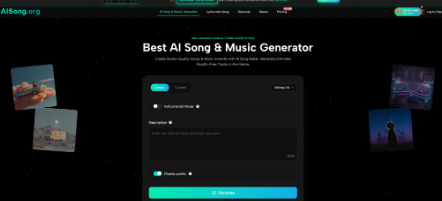
The process of converting text to song is designed to be as intuitive as a word processor, yet the output is a complex audio file.
Step 1: Inputting Or Generating The Lyrical Content
The user begins by entering their text into the system. This can be pre-written poetry, advertising copy, or lyrics generated by the platform’s own AI tools. The quality of the input text dictates the rhythm of the output.
Step 2: Selecting The Vocal And Instrumental Style
Unlike pure instrumental generation, this phase requires selecting a voice type. The user chooses the genre (e.g., Folk, Pop) and the vocal character. This decision frames how the “singer” delivers the text—whether it is a whispery, intimate delivery or a powerful, belted performance.
Step 3: Finalizing The Composition
The AI synthesizes the vocal track, aligning it with a generated instrumental backing. The result is a complete song with vocals, drums, bass, and accompaniment, ready for download.
Contrasting Silent Text With Audio-Enhanced Narrative
The following table compares the impact of standalone text versus text enhanced by AI-generated audio.
| Feature | Silent Text | AI-Musicalized Text |
| Sensory Engagement | Visual only | Visual + Auditory |
| Emotional Impact | Reader-dependent | Music-reinforced |
| Accessibility | Requires reading | Passive listening |
| Retention | Variable | Enhanced by melody |
| Format | Static | Dynamic/Shareable |
The Commercial Implications For Advertising Copy
In the world of marketing, the jingle is a powerful tool for brand recall. Historically, producing a jingle was expensive. Now, a copywriter can take a slogan, feed it into the generator with a “catchy pop” prompt, and produce a brand anthem in minutes. This allows for sonic branding to be applied to even small social media campaigns, ensuring that the brand’s message is heard as well as seen.
Democratizing The “Singer-Songwriter” Archetype
Perhaps the most profound shift is the decoupling of the “voice” from the “vocalist.” A writer no longer needs a good singing voice to produce a vocal track. The AI provides the vocal talent. This removes the physical barrier to entry for songwriting, allowing the quality of the lyrics and the composition to stand on their own merits, unhindered by the creator’s lack of performance skills.